
Video Conferencing Market Size 2026: Infrastructure and API Spend

The global video conferencing market size was $9.2 billion in 2023 and is projected to reach $19.1 billion by 2028. This growth, at a compound annual rate of 15.7%, is driven by hybrid work and the need to automate workflows around meeting data. For developers, this expansion creates a new infrastructure layer built on APIs that provide programmatic access to live conversations.
This trend is not just about more people using Zoom or Google Meet. It represents a shift from hardware-centric systems to software and API-driven solutions. Every meeting on these platforms generates data, and developers are building the tools to capture, structure, and act on that data in real time.
The main opportunity is building applications on top of this new communication fabric. These applications range from AI notetakers and sales coaching tools to interactive agents that can participate in conversations. They all depend on a reliable way to get bots into meetings and access media streams.
Why the Market Shifted from Hardware to APIs
Historically, video conferencing was defined by on-premise hardware systems. These were expensive, proprietary endpoints that required specialized IT management. The market's growth was tied to physical office expansions and hardware refresh cycles. Today, the market is dominated by cloud-based software platforms.
This shift has two major consequences for developers. First, it makes meetings universally accessible. Anyone with a browser can join, which has increased the total volume of meeting minutes. Second, it makes meetings programmable. Cloud platforms have APIs, which turns a closed communication channel into an open one that software can interact with.
This programmability is the foundation of the AI meeting assistant market. Instead of just connecting people, meeting platforms now connect people and software. This allows for the creation of tools that can transcribe, summarize, and analyze conversations, or even participate as active agents. The value is moving from the platform itself to the applications built on top of it.
The API Layer: Where Developers Create Value
The video conferencing market has two parts: the user-facing platforms and the developer-facing API layer. The platforms compete on user experience and enterprise administration features. The API layer competes on developer experience, data quality, and reliability.
An engineering team building a sales coaching tool does not want to manage a fleet of virtual machines to run meeting bots. They want a single API endpoint that can send a bot to any meeting URL. The growth in the API market is fueled by this need for abstraction. As meeting volume grows, so does the demand for APIs that handle the complexity of joining calls, capturing media, and managing platform-specific authentication.
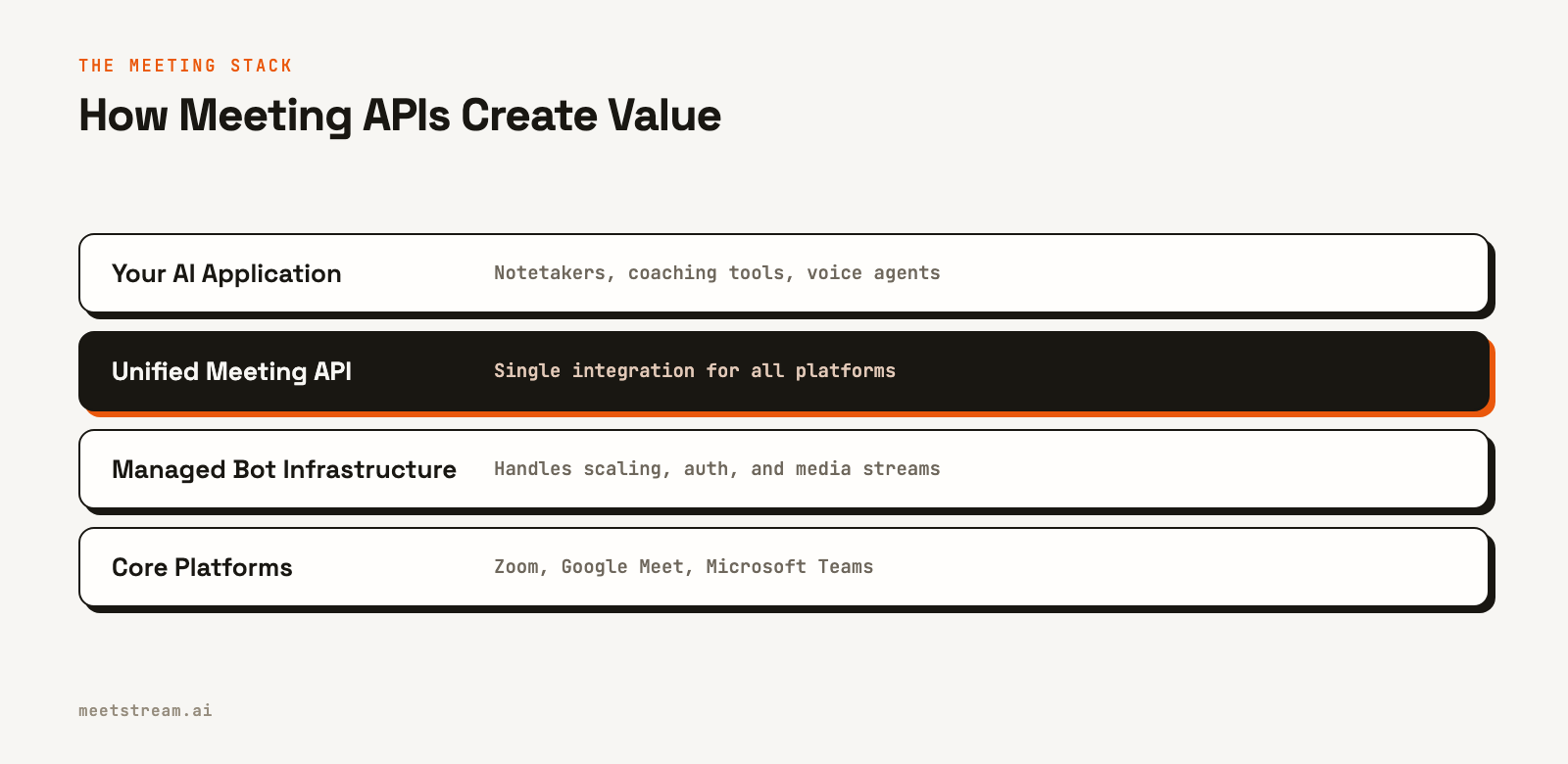
The most valuable work happens on top of this API infrastructure. Raw transcription is becoming a commodity. The real opportunity is in turning that raw text into structured data, like action items for a project management tool or objection handling signals for a CRM. Developers who use a solid meeting bot infrastructure and build intelligence on top are creating the products that enterprises will pay a premium for.
Technical Challenges of Building on Meeting APIs
Getting a bot into a meeting and streaming its audio is a complex engineering problem. Each platform has its own authentication, client SDK, and set of limitations. At MeetStream, we have processed over 1,000,000 meeting minutes and run about 80,000 bots, and we see the same challenges repeatedly.
For example, since early 2026, joining a Zoom meeting programmatically requires an On Behalf Of (OBF) token. This is a short-lived token your server must generate using OAuth credentials from a user who is already in the meeting. Your application is responsible for managing the OAuth flow and refresh tokens. You can learn more about the Zoom OBF token flow in our guide.
Media stream quality also varies. On Zoom, it is possible to get a fully isolated audio stream for each participant. On Google Meet and Microsoft Teams, the audio is a mixed stream with speaker attribution for up to three concurrent speakers. Building a reliable system requires handling these differences gracefully. An API that normalizes these streams into a consistent format saves significant development time.
Finally, scale and reliability are critical. A missed transcript for an internal sync is an annoyance. A missed recording for a regulated financial services client is a compliance failure. Building a system that can manage thousands of concurrent bots, handle waiting rooms, and gracefully retry on failure is a substantial infrastructure project that distracts from building your core product.
Real-World Applications and Implementation Patterns
Developers use meeting APIs to build a few common types of applications. The simplest pattern is a post-call transcription and summary service. This involves sending a bot to a meeting, recording the audio, and then processing it after the call ends.
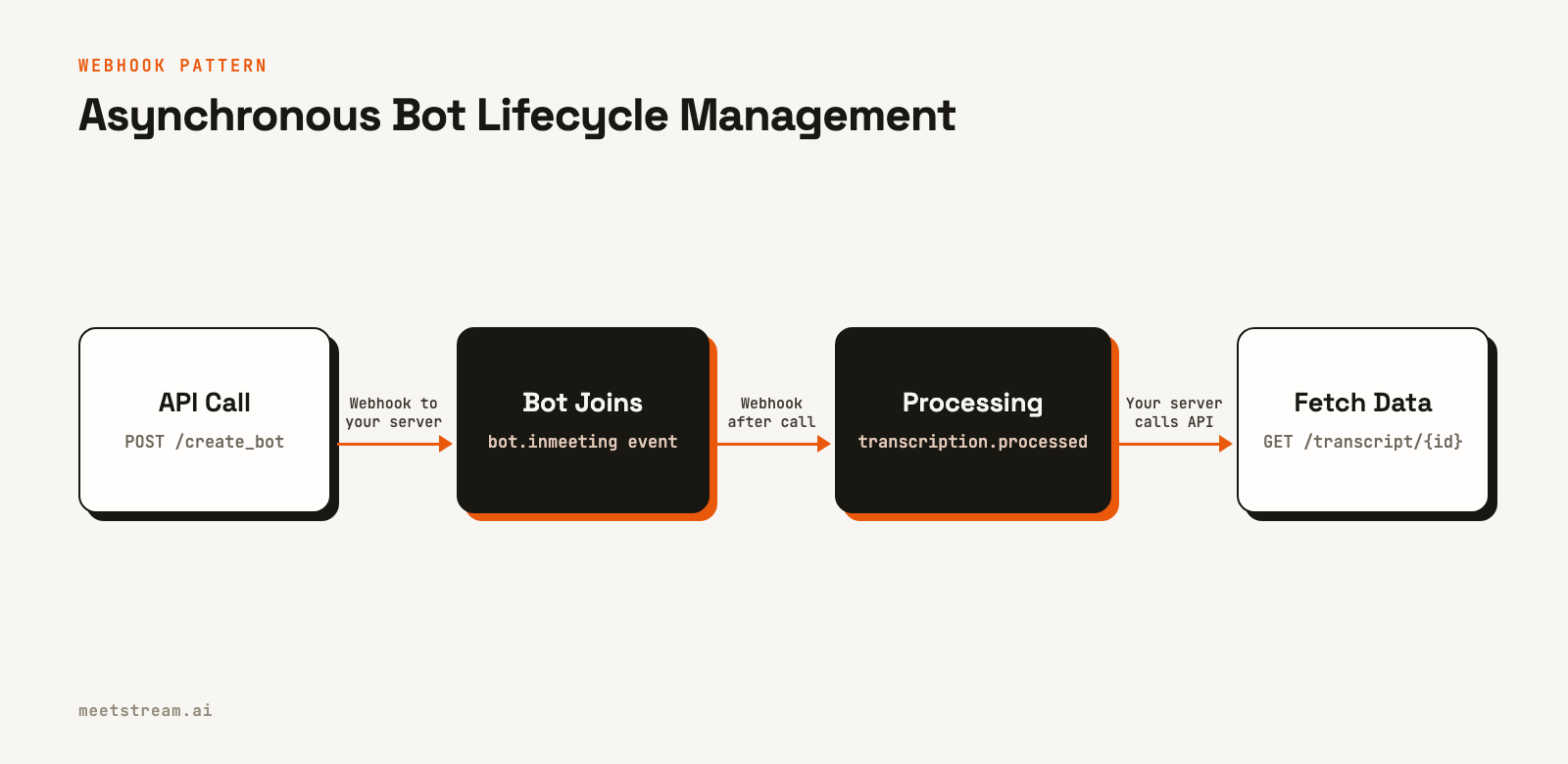
A typical implementation uses webhooks to manage the process. You would call a `create_bot` endpoint with your meeting URL and a `callback_url`. The API sends a `bot.inmeeting` event when the bot successfully joins, and a `transcription.processed` event when the transcript is ready to be fetched. This asynchronous pattern is efficient and avoids polling.
curl -X POST "https://api.meetstream.ai/api/v1/bots/create_bot" \
  -H "Authorization: Token <YOUR_API_KEY>" \
  -H "Content-Type: application/json" \
  -d '{
    "meeting_link": "<YOUR_MEETING_LINK>",
    "bot_name": "My Notetaker",
    "callback_url": "https://yourapp.com/webhooks/meetstream",
    "recording_config": {
      "transcript": {
        "provider": {
          "deepgram": {}
        }
      }
    }
  }'
A more advanced pattern involves real-time audio streaming over a WebSocket connection. This is used for applications like live sales coaching or building interactive voice agents. In this model, the API streams mixed audio with speaker metadata to your server, allowing you to run NLP models during the meeting to detect keywords or sentiment in near real time.
How MeetStream Provides Agent-First Infrastructure
MeetStream is a unified meeting bot API for Zoom, Google Meet, and Microsoft Teams. We provide the infrastructure to deploy bots and AI agents that can act as participants in a meeting. This agent-first approach means our API is designed not just for passive recording, but for active interaction.
Our platform manages the entire bot lifecycle, from joining the meeting to handling authentication and scaling to thousands of concurrent sessions. You interact with a single, consistent API regardless of the underlying meeting platform. This lets you focus on your application's logic instead of platform-specific details.
With MeetStream, a bot can listen to the conversation via a real-time audio stream and speak back using text-to-speech. It can also send messages to the chat or display an image as its video frame. This enables the creation of true AI voice agents that can answer questions, update a CRM, or perform tasks during a live conversation. The raw media streams are the foundation, but the ability to act is what makes an agent powerful.
Conclusion
The video conferencing market size continues to expand, but the most interesting growth for developers is in the API layer. As more business conversations move to these platforms, the demand for programmatic access, automation, and intelligence will only increase. Building on a dedicated meeting API provides the infrastructure needed to address this demand without getting bogged down in the complexities of real-time media and bot management. This shift creates a durable opportunity to build valuable applications on a growing foundation.
See the full API reference at docs.meetstream.ai.
Frequently Asked Questions
What is the market size for video conferencing?
The global video conferencing market was valued at $9.2 billion in 2023. It is projected to grow to $19.1 billion by 2028, which is a compound annual growth rate of 15.7%.
How does video conferencing growth affect developers?
Market growth increases the volume of meeting data generated. This creates demand for developers to build applications on top of meeting APIs for transcription, analysis, and automation. The API layer is where developers can capture value from the overall market expansion.
What is the difference between a meeting platform and a meeting API?
A meeting platform like Zoom or Teams is a user-facing application for hosting meetings. A meeting API is a developer-facing service that provides programmatic access to those meetings, allowing software to join calls, capture data, and interact with participants.
What are the main challenges in building a meeting bot?
The main challenges are handling platform-specific authentication like Zoom's OBF tokens, managing differences in media stream formats, and building a reliable, scalable infrastructure to operate bots in thousands of concurrent meetings without failure.
What is an agent-first meeting API?
An agent-first API is designed for bots that are active participants, not just passive recorders. It provides capabilities for real-time interaction, like speaking via text-to-speech and sending chat messages, enabling the development of conversational AI agents for meetings.


