
Best Meeting Transcription APIs for Developers (2026)
The tools labeled meeting transcription API are solving different jobs. An honest, category-by-category roundup for developers: bot APIs, speech-to-text engines, notetakers, and native platform streams.

The best meeting transcription API depends on the job you need to do. The term covers two distinct problems: getting audio out of a live meeting, and turning that audio into text. Some APIs only do one. This creates confusion, because a speech-to-text engine is not a substitute for an API that can join a Zoom call, and a simple recording bot is different from infrastructure for building interactive agents.
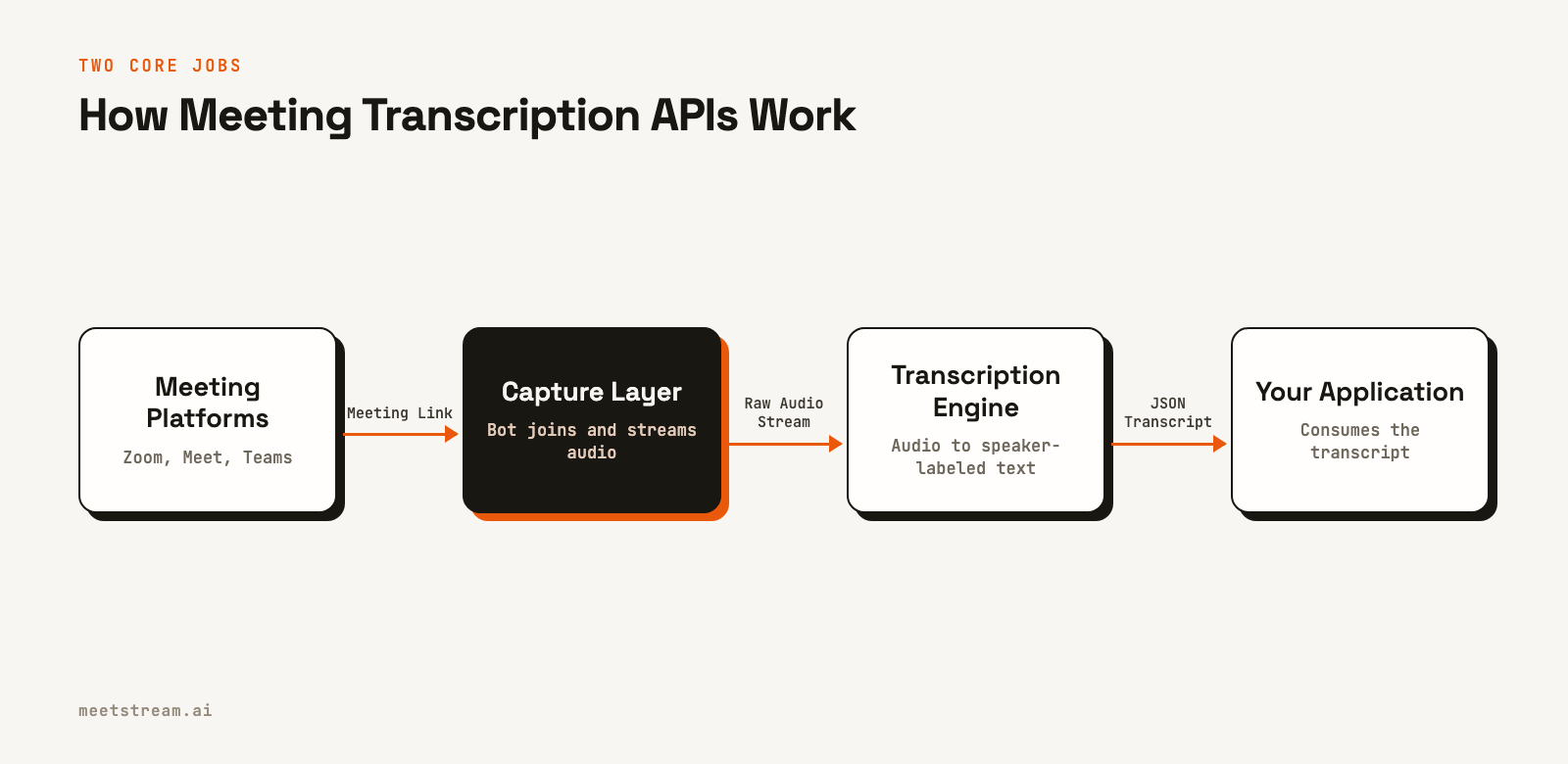
The core distinction is capture versus transcription. Capture is the hard part, involving a bot that can programmatically join a Zoom, Google Meet, or Microsoft Teams call. Transcription is the process of feeding the captured audio to a speech-to-text (STT) model. Many products that handle capture also offer transcription, but few STT providers can solve capture for you. This is why our work at MeetStream focuses on agent-first voice infrastructure for meetings. We provide the capture layer that lets agents join, hear, and act in a meeting, with transcription being one of several possible outputs.
Understanding this separation is the key to choosing the right tool. The market has three main categories: meeting bot and capture APIs, pure speech-to-text engines, and end-user notetaker apps that have a developer API. Each is built for a different use case.
What a Meeting Transcription API Does
Before comparing vendors, it is useful to separate the two main tasks. The first is getting a bot into a live meeting to access the audio stream. This is a significant infrastructure challenge, involving platform-specific authentication, media handling, and scaling for concurrent meetings. The second task is converting that audio into speaker-labeled text, either in real time or after the call ends.
Your choice of API determines which of these problems you are solving yourself. If you choose a capture API, you get a bot that handles joining meetings across platforms, and you can often choose which transcription provider to use. If you choose a pure STT engine, you are responsible for building and managing the bots that capture the audio. This distinction is the most important factor in your architecture.
Category One: Meeting Bot and Capture APIs
This category is what most developers search for when they need to get data out of meetings. You provide a meeting link, and the vendor's infrastructure deploys a bot into the call. You receive audio, video, transcripts, and lifecycle events through webhooks or WebSockets. This approach gives you a single integration to cover multiple video conferencing platforms.
Recall.ai is an established provider in this space. It supports many platforms and provides access to meeting data both in real time and post-call. It is a common choice for teams that need broad platform coverage for passive recording and transcription.
MeetStream is also in this category, but is built as agent-first voice infrastructure. The API deploys bots that can not only record but also interact in the meeting by speaking, sending chat messages, or displaying video. This is a better fit for building AI voice agents and other interactive experiences, not just for creating an archive of past conversations. We focus on providing low-latency streams and two-way communication channels.
Category Two: Speech-to-Text Engines
Speech-to-text providers like Deepgram and AssemblyAI are not meeting bot APIs. They are specialized services that excel at one thing: converting an audio stream into text. You must provide the audio yourself. Many capture APIs, including MeetStream, integrate with these STT engines, allowing you to use their models with audio captured by a meeting bot.
Deepgram is known for its low-latency streaming transcription, making it a strong choice for real-time use cases where speed is critical. Developers often use it to power live captions or to feed text to a conversational AI agent during a call.
AssemblyAI provides transcription along with a suite of audio intelligence models for tasks like summarization, sentiment analysis, and entity detection. It is often chosen when the transcript is the first step in a larger data analysis pipeline.
Using an STT engine directly makes sense only if you have already solved audio capture. For most teams building on meetings, the capture problem is the primary obstacle.
Category Three: Notetakers with a Developer API
Some end-user notetaker applications offer a developer API. These tools are designed for individuals to record and summarize their own meetings. Their APIs typically provide access to completed recordings and transcripts from a user's account. This can be a simple way to access meeting data if your users are already on that specific notetaking platform.
The main limitation is that these APIs are not designed as general-purpose infrastructure. They are usually read-only, focused on post-call data, and tied to the notetaker's user account model. This makes them a poor fit for building a product that needs to programmatically send a bot into any meeting link on behalf of your own users.
The Native Platform APIs
It is also possible to build directly on the APIs provided by Zoom, Google, and Microsoft. In recent years, these platforms have improved their real-time data access. This approach gives you the most control but also carries the highest engineering cost.
Zoom offers the most capable native option with its Meeting SDK, which can provide raw audio and video streams. Google Meet has a Media API in a limited beta for real-time data. Microsoft Teams primarily offers post-meeting transcripts through the Graph API, with limited real-time capabilities.
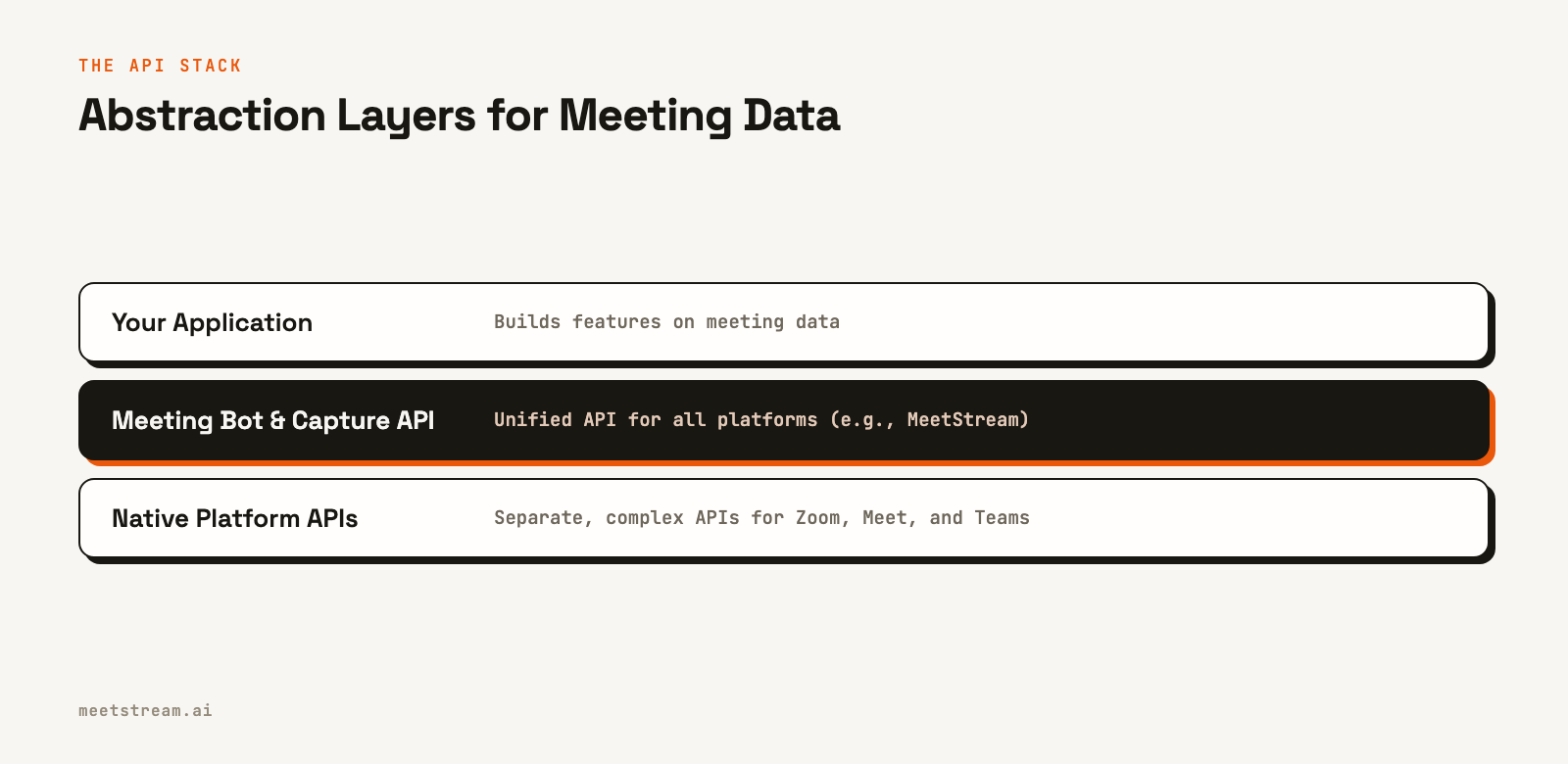
The main challenge with the native approach is that each platform is a separate, complex integration. You must handle different authentication methods, admin permissions, and data formats for each one. The purpose of a meeting bot API is to abstract this complexity away.
How to Compare Meeting Transcription APIs
Once you have identified the right category for your use case, you can compare specific tools. Benchmarks can be misleading, so focus on the architectural factors that will affect your build.
| Tool | Category | Platform Capture | Real-Time | Per-Participant Audio | Best Fit |
|---|---|---|---|---|---|
| MeetStream | Meeting Bot / Capture | Zoom, Meet, Teams | Yes | Yes (Isolated on Zoom, attributed on Meet/Teams) | Interactive agents and real-time infrastructure |
| Recall.ai | Meeting Bot / Capture | Zoom, Meet, Teams, etc. | Yes | Yes (behind feature flag) | Broad platform coverage for recording |
| Deepgram | Speech-to-Text | No | Yes | N/A | Low-latency STT on your own audio |
| AssemblyAI | Speech-to-Text | No | Yes | N/A | Transcription plus AI analysis features |
A few key questions can guide your decision:
- Platform coverage: Do you need to support one platform or all of them? A meeting bot API provides a single integration for multiple platforms.
- Real-time vs. post-call: If you are building live coaching or in-meeting agents, you need true streaming. If you only need a summary email after the call, post-call webhooks are sufficient.
- Per-participant streams: To get the highest transcript accuracy with speaker labels, you need clean audio for each person. Check if an API provides isolated audio streams per participant or just a single mixed track.
- Webhooks: A good API will provide reliable webhooks for lifecycle events like
bot.inmeetingandbot.stopped, and for processing events liketranscription.processed. - Developer experience: How quickly can you get your first bot into a call? Look for clear documentation, SDKs in your language, and a simple authentication model.
How MeetStream Fits In
MeetStream is a meeting bot and capture API designed for developers building interactive agents and real-time applications. A single API call can deploy a bot into a Zoom, Google Meet, or Microsoft Teams meeting using just the meeting link.
Our key differentiator is our focus on real-time, two-way communication. You can receive low-latency audio streams and act on them immediately. Our API provides fully isolated per-participant audio on Zoom, and speaker-attributed audio on Google Meet and Teams. This clean audio is essential for accurate multi-speaker transcription.
You can also send commands back to the bot in the meeting. This allows your application to play audio, send chat messages, or display an image as the bot's video feed. This two-way capability is what separates an interactive agent from a passive recording tool.
Here is a minimal request to deploy a bot that records a meeting and sends a webhook when the transcript is ready:
curl -X POST "https://api.meetstream.ai/api/v1/bots/create_bot" \
  -H "Authorization: Token <YOUR_API_KEY>" \
  -H "Content-Type: application/json" \
  -d '{
    "meeting_link": "https://meet.google.com/abc-defg-hij",
    "bot_name": "Notetaker",
    "callback_url": "https://your-app.com/webhooks/meetstream",
    "recording_config": {
      "transcript": {
        "provider": {
          "meetstream": {}
        }
      }
    }
  }'
The response includes a bot_id, and your webhook endpoint will receive events as the bot joins, records, and finishes processing. This infrastructure is designed to be the foundation for your meeting-based features, not just a way to get a text file after a call.
Conclusion
There is no single best meeting transcription API because the label is applied to different kinds of tools. The right choice depends on your specific needs. If you need to join arbitrary meetings and build interactive features, a capture API designed for agents is the correct starting point. If you already have audio and just need text, a specialized STT engine is a better fit.
First, match the API category to your use case. Then, compare vendors on platform coverage, real-time capabilities, audio stream quality, and overall developer experience. If your goal is to build applications that participate in meetings, start with an API that provides clean, per-participant streams and a two-way communication channel. See the full API reference at docs.meetstream.ai.
Related guides
Frequently Asked Questions
What is a meeting transcription API?
A meeting transcription API is a service that programmatically converts spoken words from meetings into text. It typically involves two parts: a capture component that joins a call to get audio, and a speech-to-text component that transcribes it. This allows applications to process and analyze meeting conversations.
How do I get a transcript from Zoom, Google Meet, and Teams with one integration?
The most direct way is to use a meeting bot API. These services provide a single endpoint that can deploy a bot into meetings on any of the major platforms. This saves you from building and maintaining separate, complex integrations for each platform's native APIs.
Can I get real-time transcription during a live meeting?
Yes, if you use an API that supports streaming. Capture APIs like MeetStream can provide a live audio stream that you can send to a real-time STT provider. Some APIs also offer a direct, live transcript stream via webhooks or WebSockets.
Do meeting transcription APIs work on free meeting plans?
Most bot-based APIs can join meetings regardless of the host's subscription plan. The bot joins as a standard participant, so it does not rely on premium platform features like cloud recording. Native platform APIs, however, often require a paid plan to access transcript data.
What is the difference between a meeting transcription API and a speech-to-text API?
A speech-to-text (STT) API only handles the transcription of an audio file or stream that you provide. A meeting transcription API, in the capture sense, also handles the difficult task of joining the live meeting to get the audio in the first place.


