
The Best Recall.ai Alternatives in 2026: 5 Meeting Bot APIs Compared
MeetStream, Nylas Notetaker, MeetingBaaS, Attendee and Skribby compared with Recall.ai on price, platforms, live media and in-meeting agents. Checked 1 October 2026.

The best Recall.ai alternative in 2026 is MeetStream, for agent-first teams whose bots listen, speak and act in calls and for product teams shipping notetakers, sales intelligence or recruiting tools. It costs $0.35 per bot hour against Recall.ai's $0.50. Nylas Notetaker, MeetingBaaS, Attendee and Skribby each win a narrower job, from Nylas-based products to self-hosting.
Updated October 2026. Prices and features were checked on 1 October 2026 against each vendor's own pricing page and documentation, and Recall.ai's pricing and platform list again on 16 October 2026. Rates change, so confirm them before you sign anything.
Recall.ai is usually the first meeting bot API a team finds, and for years it was the default. In 2026 that is less true. Recall.ai cut its price to $0.50 an hour, and the products built on meeting data changed: more of them are AI agents that need to hear the room and answer in it, not a recording to fetch the next morning.
That changes what to check before you pick a vendor:
- What does one transcribed hour cost, all in?
- Which meeting platforms can the bot join today, and which are still in beta?
- Do you get audio while the call is happening, as one mixed track or one stream per speaker?
- Can the bot speak, post in chat or show an image, or does it only listen?
- What are the licence, hosting and compliance terms?
This guide compares five Recall.ai alternatives against those questions: MeetStream, Nylas Notetaker, MeetingBaaS, Attendee and Skribby, with Recall.ai as the baseline. For the wider market, see our guide to the best meeting bot APIs.
What is the best Recall.ai alternative?
MeetStream is the best Recall.ai alternative for agent-first teams and for product teams in general. Agent-first teams get bots that join as participants, hear the room, speak back and act mid-meeting through hosted voice agents. Product teams shipping notetakers, sales intelligence, coaching, recruiting or CRM automation get recording, live and post-call transcripts and per-participant audio and video at $0.35 an hour against Recall.ai's $0.50. It supports Zoom, Google Meet and Microsoft Teams, plus Webex, GoTo Meeting, Slack huddles and WhatsApp calls in Beta, and it is the only API in this comparison that joins WhatsApp calls.
The others each win a narrower job. Choose Nylas Notetaker if your product already runs on Nylas for calendar and email. Choose Attendee or MeetingBaaS if the bots must run on your own servers and their source-available licences fit your company. Choose Skribby for low-cost audio-only notetaking. Stay on Recall.ai if you want the longest-established vendor.
How do the Recall.ai alternatives compare at a glance?
MeetStream leads on in-call agents, live media and price per transcribed hour, and each alternative fits one narrower need. Read the table from your hardest constraint, not from the cheapest number.
| API | Best for | Price per hour | Live media and in-call actions |
|---|---|---|---|
| 1. MeetStream | Best overall, for agent-first and product teams: AI agents that act in the call, notetakers, sales intelligence, coaching and recruiting | $0.35 ($0.25 at volume); $0.45 with in-house transcription | Live audio about 200 ms behind the room, live transcripts, per-participant audio and video; speaks, chats, shows images, hosted voice agents |
| 2. Nylas Notetaker | Products already on Nylas | Plan-based: 5 free hours a month, then $0.70 to $0.80 beyond plan hours; transcription included | Files arrive after the meeting; preset chat announcements, static image |
| 3. MeetingBaaS | EU hosting or a self-hosted path (BSL 1.1) | $0.50 to $0.35 per token-hour; transcription +0.25 token | Mixed live audio, live transcripts; chat, audio in, speaking bots |
| 4. Attendee | Running the bot stack yourself (Elastic License 2.0) | Hosted $0.50 to $0.35; your own transcription keys | Live audio, per-participant audio, live transcripts; speaks, chats, avatar image |
| 5. Skribby | Low-cost audio-only notes, hosted in the EU and Japan | $0.35 audio only; video +$0.05; transcribed hour $0.39 to $1.36 | Live transcripts, mixed raw audio; chat only |
| Recall.ai (baseline) | Teams that want the longest-established vendor | $0.50; transcription +$0.15 | Live audio, video and transcripts; per-participant on Zoom, Meet and Teams; chat, audio and video output |
All six join Zoom, Google Meet and Microsoft Teams. MeetStream adds Webex, GoTo Meeting, Slack huddles and WhatsApp calls in Beta. Recall.ai adds Webex, with GoTo Meeting in beta. Attendee adds Zoom RTMS, and Skribby adds Zoom and Teams webinars. If the bot has to talk, the last column decides.
How did we compare them?
On the five things that decide a build: the cost of a transcribed hour, platforms, live and per-participant media, what the bot can do in the meeting, and licence, hosting and compliance.
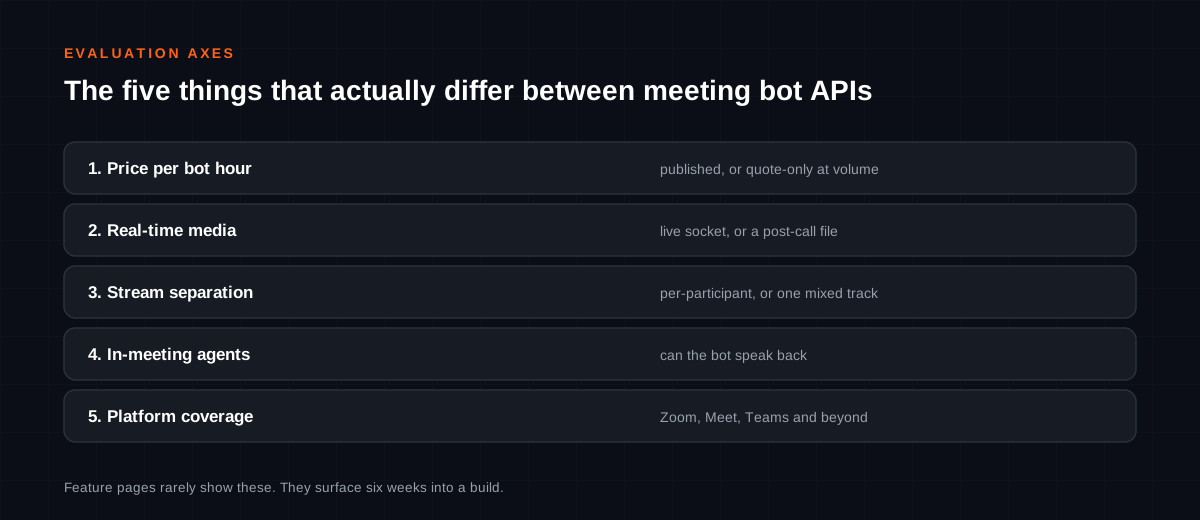
Cost of a transcribed hour. The base rate plus the transcription you would actually use, from each vendor's published pricing. We did not stack worst-case add-ons on anyone.
Platforms. Which meeting apps a bot can join today, with beta marked as beta.
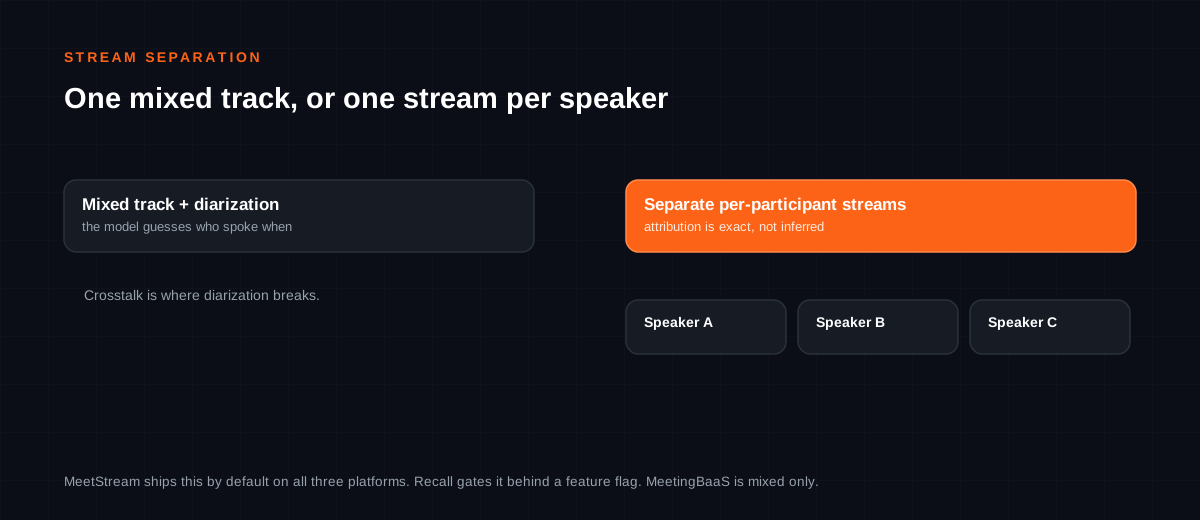
Live and per-participant media. Whether audio arrives during the call, and whether it is one mixed track or a stream per speaker. Per-speaker audio is what lets an agent know who said what without guessing.
What the bot can do in the meeting. Listening is the minimum. Speaking, posting in chat and showing visuals are what agents need.
Licence, hosting and compliance. Hosted or self-hosted, open source or source-available, and which audits are complete.
1. MeetStream: best overall, for agent-first teams and product teams
MeetStream is a meeting bot API built for agents and for the products built on meeting data. One API call sends a bot into a Zoom, Google Meet or Microsoft Teams call. The bot records and transcribes, and it can also take part: speak through text to speech, post in the meeting chat, show an image or animated GIF as its video, and run a hosted voice agent that answers on a wake word and handles interruptions. The agent runs inside MeetStream, so there is no agent server for you to host.
The media side is as complete. Live audio streams to your WebSocket about 200 ms behind the room, and live transcripts arrive with speaker names, word timings and end-of-turn flags. Per-participant audio and video are a flag each on the create call, on Zoom, Google Meet and Microsoft Teams. You choose the transcription engine per bot, from MeetStream's own to Deepgram, AssemblyAI, JigsawStack, Sarvam or the meeting's captions, and recordings can go straight to your own S3 or Alibaba OSS bucket. Typed SDKs for TypeScript and Python and an MCP server let a coding agent drive all of it.
Pricing is published on the pricing page: $0.35 per bot hour, prorated to the second, and $0.25 for select startups and at volume. In-house transcription is $0.10 an hour, per-participant streams cost nothing extra, 30 days of storage are included, calendar integration is free, and every account starts with $5 of credit. Voice agents are priced separately. A transcribed hour comes to $0.45, or $0.35 at volume.
MeetStream supports Zoom, Google Meet and Microsoft Teams, plus Webex, GoTo Meeting, Slack huddles and WhatsApp calls in Beta. Beta platforms are enabled per workspace. Contact us for access. It is ISO 27001 certified, GDPR compliant and HIPAA compliant with a BAA on request, SOC 2 Type 2 is under audit, and it has processed more than a million meeting minutes. The full head-to-head is on MeetStream vs Recall.ai.
Best for: agent-first teams building voice agents that join calls, and product teams shipping AI notetakers, sales and recruiting copilots, coaching, CRM automation, WhatsApp call capture or any product that needs live, per-speaker meeting data at a published price well below Recall.ai's.
2. Nylas Notetaker: best if your product already runs on Nylas
Nylas Notetaker is the meeting bot inside the Nylas platform, which is best known for its email and calendar APIs. If you already sync calendars through Nylas, adding a notetaker is a short step, and it arrives with the scheduling context you are already using.
It covers Zoom, Google Meet and Teams, joins Zoom as a guest without a Zoom app, and includes transcription with speaker labels and AI summaries. Its docs, updated in late September 2026, make retention configurable from five minutes to 30 days and silence auto-leave from ten seconds to an hour.
Notetaker is no longer sold at a flat hourly rate. It comes inside Nylas plans: a free plan with five bot hours a month, Essentials at $15 a month with 10 hours and then $0.80 an hour, and Pro at $49 a month with 70 hours and then $0.70 an hour.
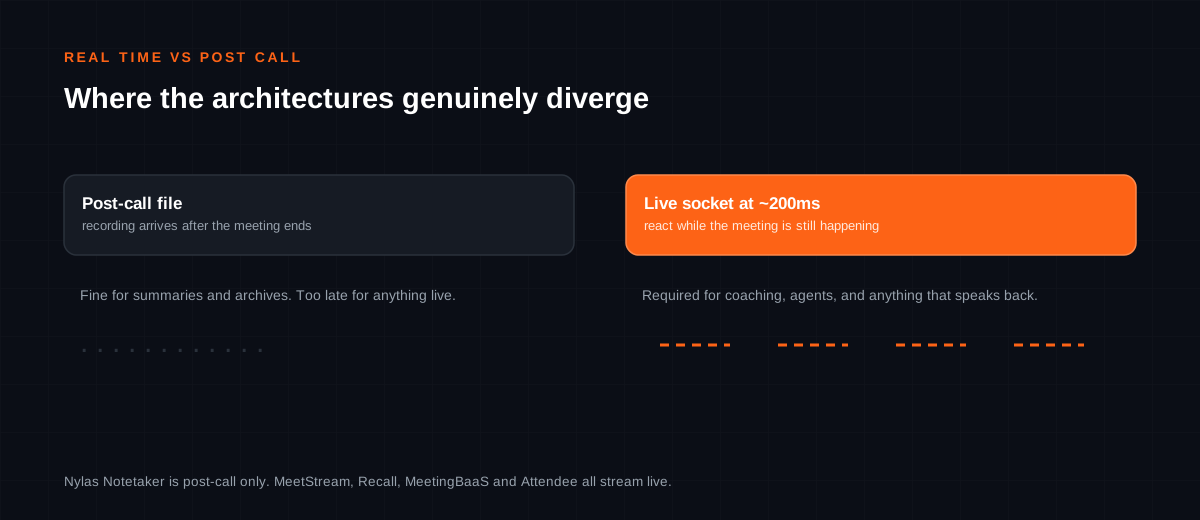
The tradeoff is that everything arrives after the meeting. There is no live audio or transcript stream, the recording is one mixed track rather than a stream per person, and in-meeting actions stop at preset chat announcements and a static image. For a side-by-side of the two, see Recall.ai vs Nylas Notetaker, and for MeetStream against Nylas, MeetStream vs Nylas Notetaker.
Best for: calendar and scheduling products already on Nylas that need post-call recordings and transcripts.
3. MeetingBaaS: best for EU teams that want a self-hosted path
MeetingBaaS is a Paris-based meeting bot API for Zoom, Google Meet and Teams, sold as a hosted service with code you can also run yourself. It leans on flexibility: bring your own storage, bring your own transcription keys, and create bots in batches.
Live media comes as a WebSocket of mixed meeting audio in both directions, with managed real-time transcription from several providers. Bots can post in chat and, through its speaking bots built on Pipecat, talk in the meeting.
Pricing is token-based. One token is one recording hour, from $0.50 in small packs down to $0.35 in the largest, with eight free hours to start. Transcription adds a quarter of a token an hour, and streaming adds a tenth of a token per direction. Monthly plans from $0 to $299 set limits and retention rather than usage.
The tradeoff is the licence and the media model. The core is source-available under the Business Source License, not open source, and internal use at companies with more than 100 staff or $5M in revenue needs a paid licence. Live audio is mixed, with no per-participant stream, and its December 2025 launch post said it was not yet SOC 2 compliant. Our Recall.ai vs MeetingBaaS comparison goes deeper.
Best for: EU-based teams that want EU hosting or a self-hosted option, and recording workloads where mixed audio is enough.
4. Attendee: best for teams that want to run the bot stack themselves
Attendee is a meeting bot API you can self-host or use as a hosted service. Its code is public on GitHub and it is often described as open source, but the licence is the Elastic License 2.0, which lets you run it yourself and not resell it as a hosted service.
It joins Zoom, Google Meet and Teams, supports Zoom RTMS for capture without a bot, streams audio both ways over WebSocket, and added per-participant audio in January 2026. Bots can speak, chat and show an avatar, and you can load a browser-based voice agent.
Hosted pricing is five free hours, then $0.50 an hour, falling to $0.35 at volume. Transcription runs on your own provider keys or the platform's free captions. Self-hosting has no licence fee, so the cost moves to your compute, your storage and the engineers who keep the bots joining.
The tradeoff is the operational load when you self-host. The browser fleet, scaling, and the join flows that break whenever Zoom, Meet or Teams changes its interface all become yours, and it does not publish SOC 2, HIPAA or ISO certifications. See Recall.ai vs Attendee and our guide to open-source Recall.ai alternatives.
Best for: teams with infrastructure engineers and strict data-residency rules that want the bot stack on their own servers.
5. Skribby: best for low-cost audio-only notetaking
Skribby is a hosted meeting bot API for Zoom, Google Meet and Teams, including Zoom and Teams webinars, and is now part of Alianza. It is built for simple notetaking with a short setup.
It offers a real-time transcript and event WebSocket, a separate socket of mixed raw audio, a wide choice of transcription models with bring-your-own-key, and chat actions including Zoom direct messages. It runs in EU and Japan regions.
The headline $0.35 an hour covers the bot and an audio-only recording. Video adds $0.05, real-time features add $0.05, and transcription is priced per model, which puts a transcribed hour between $0.39 and $1.36. The free plan includes five bot hours a month.
The tradeoff is depth. Per-participant streams are not documented, there is no documented way for the bot to speak in the meeting, and the only compliance it publishes is GDPR and encryption. More in Recall.ai vs Skribby.
Best for: lightweight notetakers, especially in Europe or Japan, that need transcripts more than video or in-meeting agents.
What are the best Nylas Notetaker alternatives?
MeetStream is the best Nylas Notetaker alternative, for agent-first teams and for product teams that need meeting data during the call. Nylas delivers recordings and transcripts after the meeting; MeetStream streams live audio about 200 ms behind the room and live transcripts, adds per-participant audio and video, and bills only the hours you run at $0.35, with no plan underneath.
Recall.ai is the other hosted option with live media, and Attendee or MeetingBaaS fit if you want to self-host. If calendar sync is why you chose Nylas, MeetStream's Google and Microsoft calendar integration is free and sends bots to the meetings on a connected calendar. Compare the two directly on MeetStream vs Nylas Notetaker.
When is Recall.ai still the right choice?
When your team wants the longest-established vendor in the category. For most other products, MeetStream covers the same core job at a lower published price and hosts the voice agent for you.
Recall.ai's bots join Zoom, Google Meet, Teams and Webex, with GoTo Meeting in beta, according to its platform documentation as of October 2026, and it ships a desktop recording SDK. It holds a SOC 2 Type 2 report, ISO 27001 and HIPAA, reports more than 3,000 customers, and offers live audio, video and transcripts plus media output for agents.
As of October 2026, pricing is $0.50 an hour with five free hours, transcription at $0.15, and seven days of storage before $0.05 per hour retained, with a $0.25 introductory rate for the first 10,000 hours in its startup program. Separate per-participant video needs its web4core bot variant, and separate audio is not available on Webex or GoTo Meeting.
Is Recall.ai worth it, or is there a cheaper alternative?
Recall.ai is a capable, long-established API, but for most builds MeetStream does the same core job for less: a transcribed hour costs $0.45 against $0.65 on Recall.ai's published October 2026 pricing, and MeetStream includes 30 days of storage where Recall.ai includes seven.
On 1,000 bot hours a month with transcription and 30 days of retention, that is about $700 on Recall.ai's list rates against $450 on MeetStream. Recall.ai's $0.25 startup rate covers a first 10,000 hours in its program; MeetStream's rate moves toward $0.25 an hour at volume and for select startups. The Recall.ai pricing breakdown works through more volumes, and MeetStream vs Recall.ai has a cost calculator.
What does a transcribed hour cost on each?
MeetStream has the lowest published rate here for a transcribed hour with video at volume: $0.35, or $0.45 at list. Like for like, one recorded, transcribed hour at each vendor's published rate, without optional add-ons:
| API | Recording, per hour | Transcribed hour | Worth knowing |
|---|---|---|---|
| MeetStream | $0.35 ($0.25 at volume) | $0.45 ($0.35 at volume), in-house transcription +$0.10 | Per-participant streams included; 30 days of storage |
| Recall.ai | $0.50 | $0.65, transcription +$0.15 | 7 days of storage, then $0.05 per hour retained |
| MeetingBaaS | $0.50 to $0.35 per token | About $0.44 to $0.63, transcription +0.25 token | Depends on token pack; streaming extra |
| Attendee (hosted) | $0.50 to $0.35 | $0.35 to $0.50 plus your provider's rate | Self-hosting moves the cost to your infrastructure |
| Skribby | $0.35 audio only | $0.39 to $1.36, priced per model | Video adds $0.05 |
| Nylas Notetaker | Plan-based | $0.70 to $0.80 beyond plan hours, transcription included | Pro at $49 a month includes 70 hours |
At list price, MeetingBaaS's largest prepaid token pack lands at a similar figure to MeetStream, and Nylas plans include a set number of hours each month. MeetStream adds per-participant audio and video, 30 days of storage and hosted voice agents at that rate.
How do I choose a Recall.ai alternative?
Choose MeetStream if you are an agent-first team or a product team shipping on meeting data: notetakers, sales intelligence, coaching, recruiting or CRM automation. Pick another API only when one narrower constraint decides.
| If you need | Choose | Why |
|---|---|---|
| An agent that joins, listens, speaks and acts in the call | MeetStream | Hosted voice agents, chat and visuals, live audio about 200 ms behind the room |
| A product on meeting data: notetaker, sales intelligence, coaching, recruiting or CRM automation | MeetStream | Recording, live and post-call transcripts, participant events and per-participant files from one API at $0.45 an hour all in |
| Per-speaker audio and video without a surcharge | MeetStream | $0.35 an hour, per-participant streams included |
| WhatsApp calls, Webex, GoTo Meeting or Slack huddles on the same API | MeetStream | In Beta, enabled per workspace; the only API here that joins WhatsApp calls |
| The longest-established vendor | Recall.ai | Reports more than 3,000 customers |
| A product already on Nylas calendar and email | Nylas Notetaker | One platform, transcription included |
| Bots on your own servers | Attendee or MeetingBaaS | Source-available code; check the licence terms first |
| Low-cost audio-only notes | Skribby | $0.35 an hour without video |
How hard is it to switch from Recall.ai?
Not hard. Both are REST APIs built the same way: create a bot with a meeting link, receive lifecycle webhooks, then fetch recordings and transcripts. In practice you change the base URL, switch the auth header to Token, and map webhook fields (MeetStream sends bot_event with a status_code). For authenticated Zoom joins, MeetStream fetches the OBF or ZAK token from a URL you host.
Frequently asked questions
What is the best Recall.ai alternative?
MeetStream, for agent-first teams and for product teams building on meeting data. It costs $0.35 an hour against $0.50, includes per-participant streams, and its bots can speak and act in the call through hosted voice agents. It supports Zoom, Google Meet and Microsoft Teams, plus Webex, GoTo Meeting, Slack huddles and WhatsApp calls in Beta. Nylas Notetaker suits products already on Nylas, Attendee and MeetingBaaS suit self-hosting, and Recall.ai suits teams that want the longest-established vendor.
Is Recall.ai worth it, or is there a cheaper alternative?
Recall.ai is a capable, long-established API. For most products MeetStream is the cheaper alternative for the same core job: a transcribed hour is $0.45 against $0.65 on Recall.ai's list pricing as of October 2026, and 30 days of storage are included against seven.
What is the cheapest Recall.ai alternative?
For a transcribed hour with video, MeetStream is $0.45 at list and $0.35 at volume, against $0.65 on Recall.ai. At list, only MeetingBaaS's largest prepaid token pack comes in at a similar figure, and at volume MeetStream's $0.35 is the lowest here. Skribby's $0.35 base is audio only, and self-hosting Attendee has no licence fee but moves the cost to your own infrastructure.
What are the best Nylas Notetaker alternatives?
MeetStream is the best Nylas Notetaker alternative for products that need meeting data during the call: live audio about 200 ms behind the room, live transcripts, per-participant audio and video, and bots that speak. It bills $0.35 per bot hour with no plan underneath. Recall.ai is the other hosted option with live media, and Attendee or MeetingBaaS fit if you want to self-host.
Is there an open-source Recall.ai alternative?
Not in the strict sense among the main options. Attendee publishes its code under the Elastic License 2.0 and MeetingBaaS under the Business Source License 1.1. Both are source-available: you can read and self-host the code, with limits on reselling it and, for MeetingBaaS, a paid licence for larger companies.
Which Recall.ai alternative is best for real-time AI agents?
MeetStream. Live audio reaches your WebSocket about 200 ms behind the room, live transcripts carry speaker names and end-of-turn flags, and the bot can answer by voice, chat or image. Nylas Notetaker delivers files only after the meeting, so it cannot power a live agent.
Does any meeting bot API support WhatsApp calls?
MeetStream does, in Beta, through the same API it uses for Zoom, Google Meet and Microsoft Teams. Webex, GoTo Meeting and Slack huddles are also in Beta. Beta platforms are enabled per workspace. Contact us for access. None of the other APIs in this comparison list WhatsApp support.
How much does Recall.ai cost per hour?
As of October 2026, Recall.ai lists $0.50 per recording hour pay-as-you-go with the first five hours free, plus $0.15 an hour for its built-in transcription. Storage is free for seven days, then $0.05 per hour of recording retained for 30 days. Its startup program offers $0.25 an hour for the first 10,000 hours. On MeetStream the same transcribed hour is $0.45, with 30 days of storage included.


