
Meeting Recording Retention: Storage, Compliance and Cost

Every meeting recording your application creates is a compliance liability. The moment a bot joins a call and starts capturing audio, you become responsible for that data. Storing it indefinitely is not a viable strategy; it increases risk, raises costs, and violates data privacy principles core to regulations like GDPR.
This problem has grown as AI meeting agents become more common. At MeetStream, we've processed over a million meeting minutes, and we see firsthand that developers are often focused on the immediate task of capture and transcription. The long-term data lifecycle, however, is where significant legal and financial risks accumulate. This is not just a legal checkbox, it is a critical part of your system architecture.
Meeting recording retention is the set of policies and technical controls that govern how long you store recordings and when you must permanently delete them. A sound retention policy balances business needs, like user access to past meetings, with legal obligations for data minimization and the right to erasure. It is a deliberate, automated process, not an afterthought.
This post breaks down the technical and legal requirements for handling meeting recordings. We will cover the core compliance frameworks, best practices for secure storage, and how to implement an automated data lifecycle policy. Let's get into it.
Why Recording Retention Is a Core Concern
Failing to manage meeting recordings properly creates direct technical and business risks. The consequences of non-compliance are not abstract. They include large fines, especially under regulations like GDPR where penalties are tied to revenue, and a loss of customer trust that is difficult to recover.
From an engineering perspective, a clear retention policy simplifies system design. It prevents unbounded data growth, which keeps storage costs predictable and database queries performant. More importantly, it provides a defensible, automated answer to the question, "Why do you still have this user's data?"
Key regulations directly impact how you must handle this data. The EU's General Data Protection Regulation (GDPR) requires a lawful basis for storing personal data and mandates its deletion upon user request. In the US, the Health Insurance Portability and Accountability Act (HIPAA) sets strict rules for protecting patient information, while frameworks like SOC 2 demand auditable proof of your security and data management controls.
Key Compliance Frameworks Explained
Handling the compliance landscape means understanding the technical implications of each major framework. These are not just legal documents; they are specifications for your system.
- GDPR (General Data Protection Regulation): This EU law applies if any meeting participant is in the EU. Its core principles are data minimization, meaning you should only store what you need for as long as you need it, and the "Right to Erasure." This requires you to have a reliable, auditable mechanism to permanently delete a user's data on request.
- HIPAA (Health Insurance Portability and Accountability Act): For applications in the US healthcare space, HIPAA governs the use of Protected Health Information (PHI). If a meeting could contain PHI, you must have a Business Associate Agreement (BAA) with your infrastructure provider. All storage and access must be secure, encrypted, and logged.
- SOC 2 (Service Organization Control 2): A SOC 2 report validates a company's controls for security, availability, processing integrity, confidentiality, and privacy. For meeting recordings, this means demonstrating you have enforced policies for encryption, access control, and data lifecycle management. An audit will require you to produce logs proving these controls are working. MeetStream is currently under audit for SOC 2 Type 2 and is ISO 27001 certified.
Technical Best Practices for Secure Storage
A compliant retention policy depends on a secure storage foundation. Storing recordings involves more than just writing a file to a disk; it requires a multi-layered approach to security.
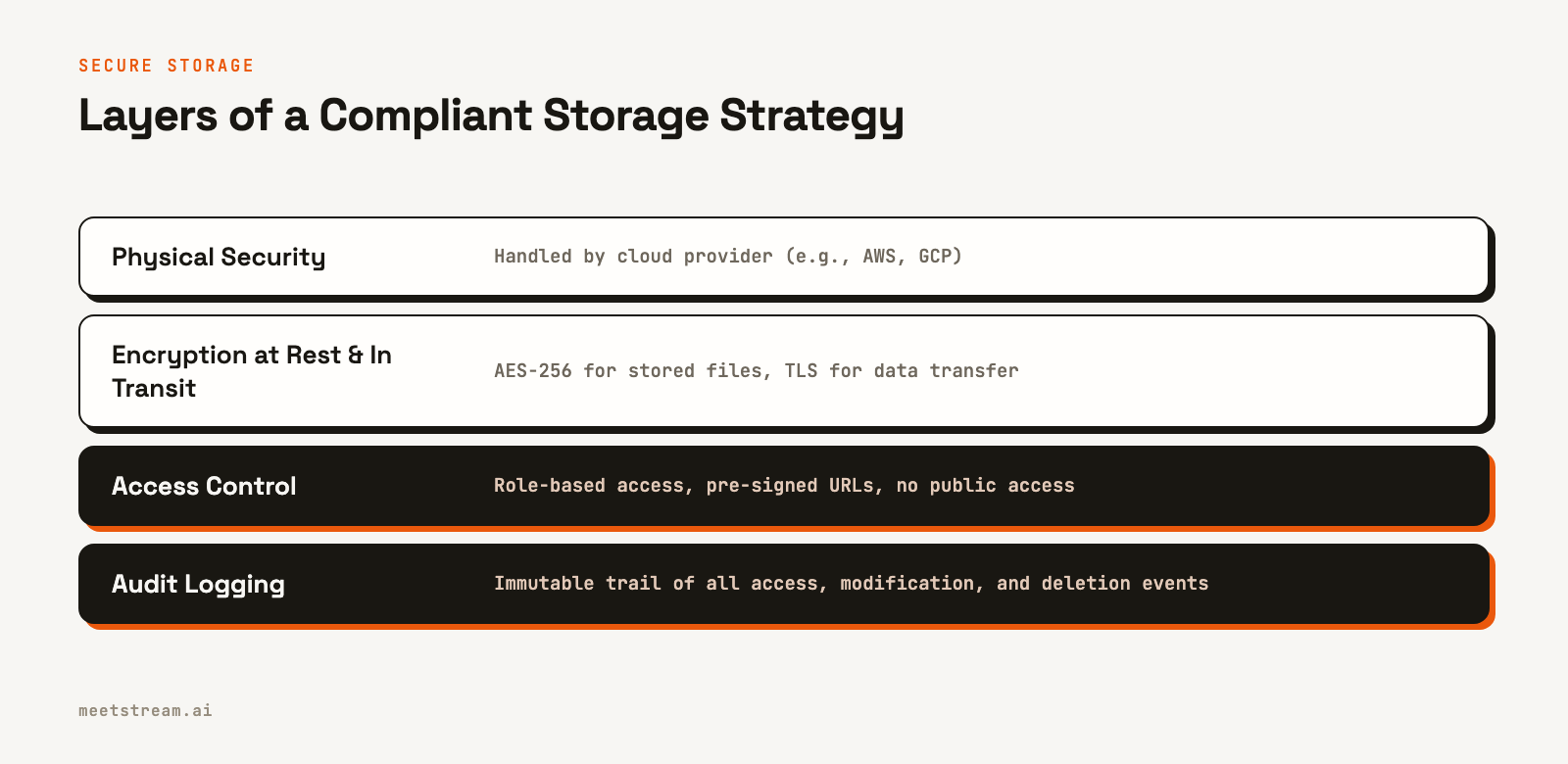
First, all data must be encrypted. Encryption in transit, using protocols like TLS, protects data as it moves from the meeting platform to your storage. Encryption at rest, using standards like AES-256, protects the stored files from unauthorized access. This is a baseline requirement for all major compliance frameworks.
Second, access control must be strict. The principle of least privilege should apply, meaning only authorized users and systems can access recordings. A common and effective pattern is to use pre-signed URLs with short expiration times for user-facing access. This avoids making storage buckets public and ensures every access attempt is temporary and auditable. You should log every request to generate a URL, tying it to a specific user and recording ID.
Finally, data residency is a critical consideration. Regulations like GDPR often have specific rules about where data can be stored and processed. You must use infrastructure that allows you to store recordings within specific geographic regions, such as the US or EU, to meet these requirements.
Implementing a Data Lifecycle Policy
A data lifecycle policy defines the stages a recording goes through, from creation to final deletion. The most important part of this policy is that it must be automated. Manual deletion is prone to error and is not a scalable or defensible compliance strategy.
The first step is to define your retention periods. These will vary based on your industry and use case. For a sales coaching tool, you might retain calls for 90 days. For a financial services application subject to FINRA, the requirement could be several years. The default should always be the shortest period that meets your business and legal needs.
Once a period is defined, the system should automatically delete the data when it expires. This process should be permanent and auditable. Your system should create a log entry for every automated deletion, providing a clear record that you are following your stated policy. This is your proof of compliance during an audit.
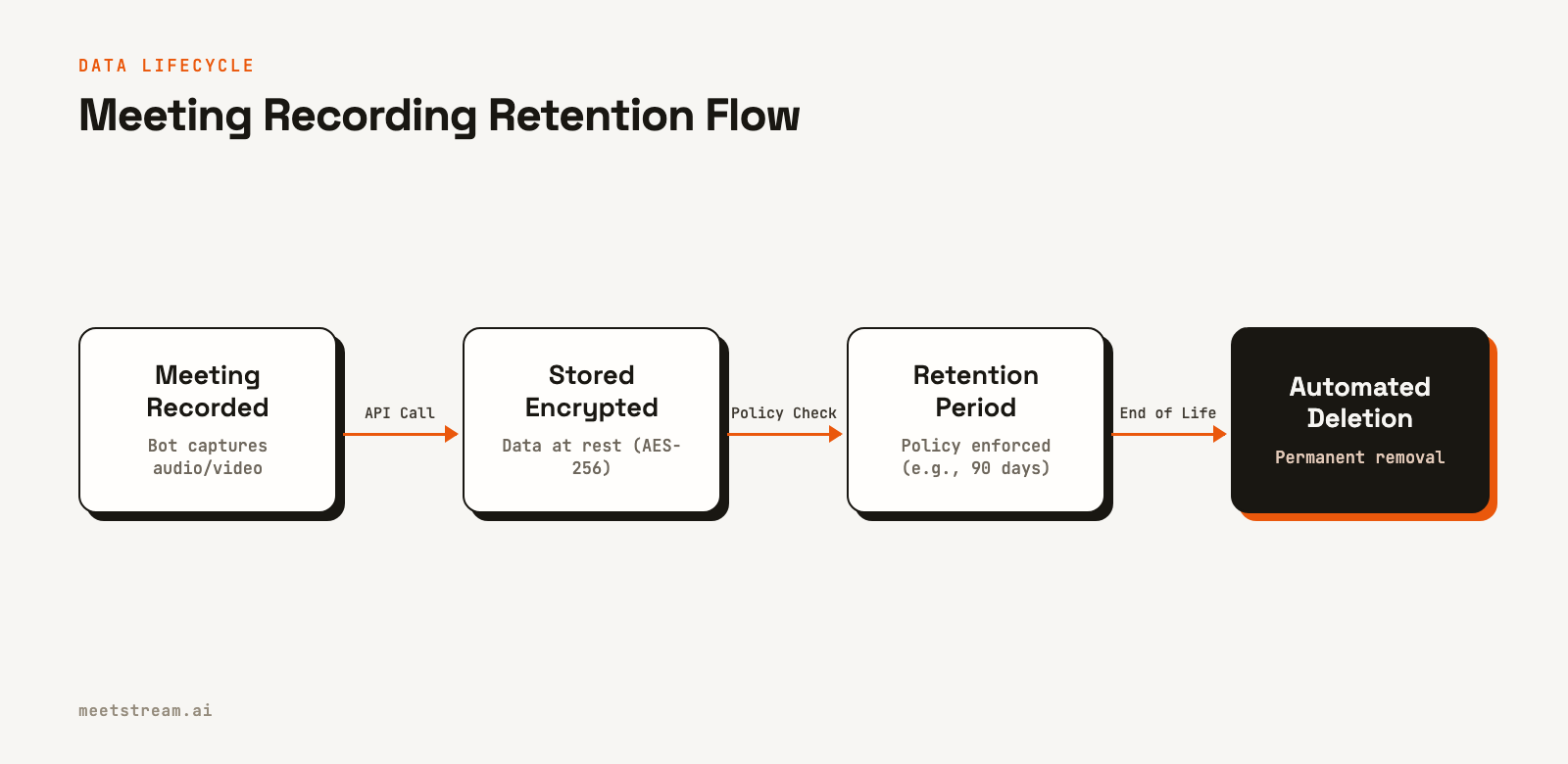
Handling user-initiated deletion requests under laws like GDPR also requires an automated workflow. When a user invokes their "Right to Erasure," your system should be able to identify all their associated recordings and queue them for immediate, permanent deletion.
How MeetStream Manages Recording Retention
MeetStream is designed as agent-first voice infrastructure for meetings. Our platform enables AI voice agents to join calls, listen, and act in real time. Recording and transcription are outputs of this core capability, and we've built compliance controls directly into the API.
By default, 30 days of recording storage are included. Extended retention beyond that is billed at $0.05 per GB per month. This aligns with the principle of data minimization. For teams that need longer-term storage for compliance or other business reasons, you can specify a custom retention period directly in the API call when creating a bot.
Here’s how you would configure a bot to retain a recording for one year:
curl -X POST "https://api.meetstream.ai/api/v1/bots/create_bot" \
  -H "Authorization: Token <YOUR_API_KEY>" \
  -H "Content-Type: application/json" \
  -d '{
    "meeting_link": "<YOUR_MEETING_LINK>",
    "bot_name": "Compliance Bot",
    "callback_url": "https://your-app.com/webhooks/meetstream",
    "recording_config": {
      "retention": {"type": "timed", "hours": 8760},
      "transcript": {
        "provider": { "meetstream": {} }
      }
    }
  }'
The retention object allows you to set a timed policy in hours. In this example, we set the retention period to 8760 hours (one year). When this period ends, MeetStream automatically deletes the recording and all associated data. We then send a data_deletion event to your webhook URL, providing an auditable confirmation that the data has been purged from our systems.
Conclusion
Effective meeting recording retention is a function of your system's architecture, not just a legal policy document. It requires a commitment to secure storage practices, including end-to-end encryption and strict access controls. Most importantly, it depends on automated, auditable data lifecycle management.
By defining clear retention periods and building automated deletion into your workflow, you can meet your compliance obligations under frameworks like GDPR and HIPAA. This approach reduces risk, controls costs, and builds trust with your users by demonstrating responsible data stewardship. For developers building on meeting data, a reliable retention strategy is a requirement for shipping a production-ready application.
See the full API reference at docs.meetstream.ai.
Related guides
- Compliance Recording for Financial Services: Meeting Bot API Guide
- Compliance meeting recording API for regulated teams
- Meeting Bot API for Zoom, Google Meet & Teams
- Google Meet Bot API
Frequently Asked Questions
What are the main storage options for meeting recordings at scale?
The standard for scalable storage of meeting recordings is cloud object storage, such as Amazon S3 or Google Cloud Storage. These services are cost-effective and provide tools for managing data lifecycles, which is essential for implementing automated retention and deletion policies.
What retention period should I set for meeting recordings?
Retention periods depend on your specific compliance needs. For businesses covered by HIPAA, a six-year retention period is often required. For many other businesses, a 90-day period is a good starting point that balances utility with the data minimization principles of GDPR.
How do I implement access controls for stored meeting recordings?
Use pre-signed URLs with short expiration times instead of making storage buckets public. When a user needs to access a recording, your application should generate a temporary URL. This ensures that access is time-limited and you can log every request for a complete audit trail.
How do I handle recording deletion requests under GDPR?
You need a documented and automated process. When a user requests deletion, your system should identify all associated data, permanently delete it from your primary storage, and ensure it is also removed from any backups. The deletion event should be logged for auditing purposes.
Can I pause and resume recording during a meeting?
Yes, pausing a recording during sensitive parts of a conversation is a good practice for data minimization. A meeting recording API should provide endpoints to pause and resume recording mid-call, giving you granular control over what gets captured and stored.


