MeetStream developer resources
Everything you need to build on the MeetStream meeting bot API. Docs, the OpenAPI contract, MCP servers, auth, webhooks, tooling and the agent discovery endpoints.
What is the MeetStream API?
MeetStream is a meeting bot API. One authenticated request puts a bot into a Zoom, Google Meet, or Microsoft Teams call.

The bot records the meeting and streams speaker-tagged live audio and video. It transcribes the call and can speak back into the room.
What does each surface give you?
Guides and reference, with a plain Markdown twin for every URL.
43 paths and 57 operations, each with a unique name and a short note.
Self-serve, and every new account includes $5 of free credit.
MCP servers, agent skills, and the discovery files an agent reads.
After the call it returns per-participant audio and video files. Every developer and agent surface below sits at a fixed URL.
Read the docs, then take the contract
Two ways in. Browse the guides, or import the machine-readable contract straight into your stack.
- Guides and referenceThe docs cover the bot lifecycle, transcripts, participants, calendar bookings and webhooks.
- Built for agents tooEach docs URL has a plain Markdown twin, and each section has an index built for agents.
- OpenAPI 3.1Published at meetstream.ai/openapi.json. Import it into an LLM tool stack, Postman, or a generated client.
Where each surface lives
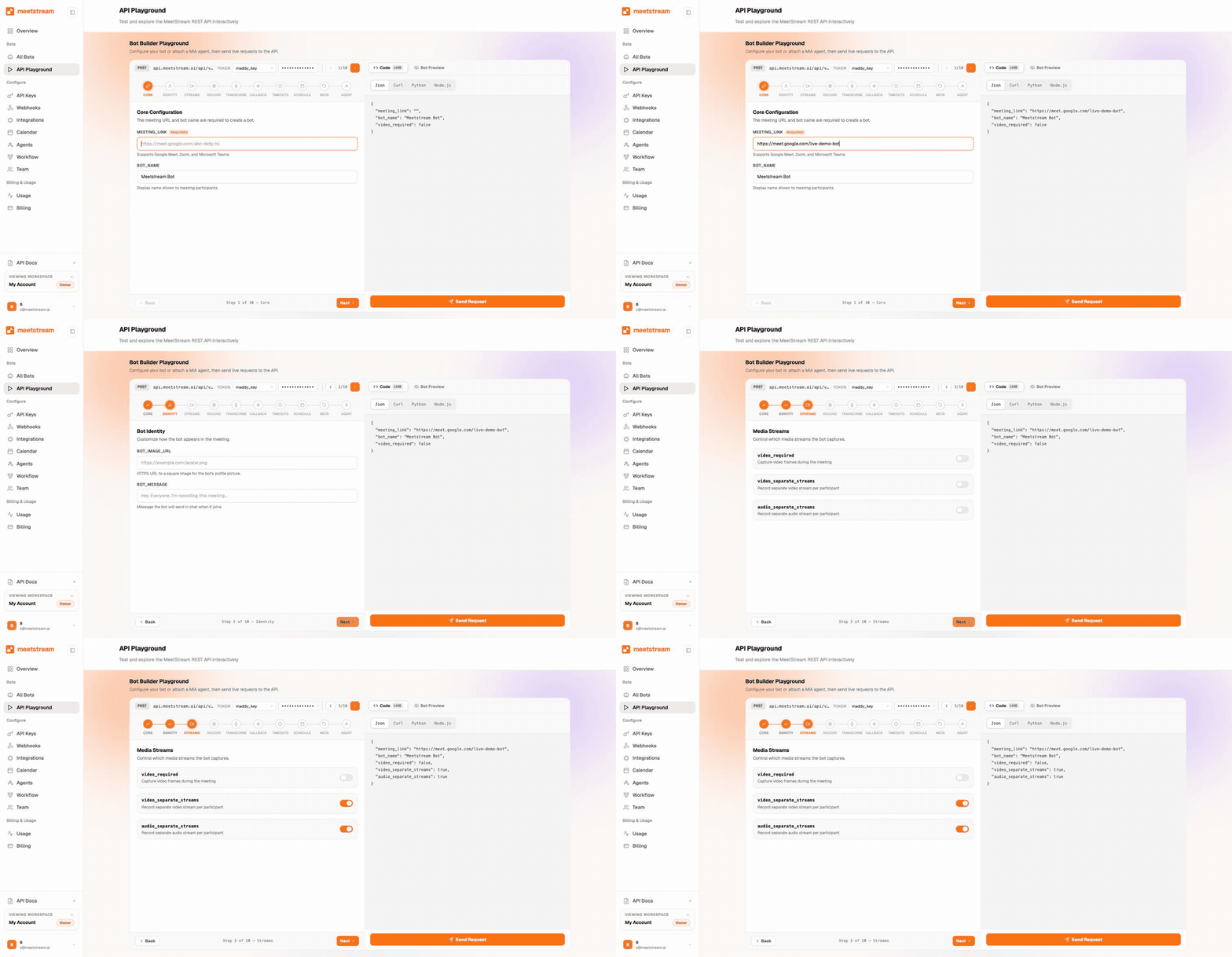
The full docs live at docs.meetstream.ai. Build a request in the browser first if you prefer.
How do you authenticate?
MeetStream uses an API key, sent in the authorisation header.
- Keys are self-serveCreate one at app.meetstream.ai and run your first bot right away.
- Free credit to start withEvery new account includes $5 of free credit.
- One guide for agentsThe auth guide gives the header, status codes and key revocation in full.
Quickstart
Send a bot into a meeting with a single request:
curl -X POST https://api.meetstream.ai/api/v1/bots/create_bot \
  -H "Authorization: Token $MEETSTREAM_API_KEY" \
  -H "Content-Type: application/json" \
  -d '{"meeting_link": "https://meet.google.com/abc-defg-hij", "bot_name": "Notetaker"}'
Poll the bot status endpoint until the bot has joined, then read the transcript once the call ends. The Meeting Bot API covers the flow.
Billing runs per bot-hour, so remove a bot as soon as its work is done. Rates are on the pricing page.
Build from an agent or a terminal
The MeetStream MCP server gives Claude, Cursor and any other MCP client a set of tools.
- Connect over HTTPAdd https://mcp.meetstream.ai/mcp and sign in with OAuth. There is nothing to install.
- A docs server as wellA second, read-only server covers the docs and is open to any client.
- The MeetStream CLICreate and manage meeting bots from a terminal. It installs from npm.
Agent skills and source
Agent skills install into Claude Code as a plugin from the MeetStream marketplace on GitHub.
The same skills sit at /.well-known/agent-skills for any agent that reads the index.
The server card lists the address of each MCP server. Source for both tools is on the same GitHub organisation.
Agent discovery endpoints
MeetStream publishes the standard files agents look for. A client can find and check each one without reading HTML.
- /llms.txt and /llms-full.txt for the site index built for agents
- /agents.md, /developers.md and /pricing.md as plain Markdown
- /.well-known/ai-catalog.json for Agentic Resource Discovery
- /.well-known/mcp for MCP discovery and /.well-known/agent-card.json for A2A
- /.well-known/api-catalog (RFC 9727) and /.well-known/oauth-protected-resource (RFC 9728)
Every page here also has a Markdown twin. Ask for Markdown in the request header, or add the Markdown suffix to any path.
Events reach your handler through webhooks, so an agent can act the moment a call ends.
Enterprise-level security, keep your data private.
The certificate, the audit status and the Trust Center are all on the security page.
MeetStream is ISO 27001 certified, with SOC 2 Type 2 under audit.
MeetStream is GDPR compliant, and bots run in the United States by default.
Bring-your-own S3 means recordings can live in your storage from the moment they are written.



Where a request runs
Data is encrypted in transit and at rest. The security page has the certificates.
Got a question? We got the answer.
Common questions about keys, the contract, the MCP servers and the files built for agents.
How do I get a MeetStream API key?
Sign up at app.meetstream.ai and create a key in the dashboard. It is self-serve, and every new account starts with $5 of free credit, so you can run a first bot right away.
Where is the OpenAPI specification?
The contract is published as OpenAPI 3.1 at meetstream.ai/openapi.json. It lists 43 paths and 57 operations. Each one has a unique name and a short note, so a generated client reads cleanly.
What can the MCP server do?
It gives Claude, Cursor and any other MCP client tools for creating and reading meeting bots. Add the hosted URL and sign in with OAuth; there is nothing to install. A second server covers the docs.
Is there a Markdown version of the docs?
Yes. Each docs URL has a plain Markdown twin, and so does each page on this site. Ask for Markdown in the request header, or add the Markdown suffix to any path.
How do I know when a recording is ready?
Webhooks fire on bot lifecycle events, and again when recordings and transcripts are ready. Your app can act the moment a call ends instead of polling for it.
One key, and the whole meeting stack.
Docs, an OpenAPI contract, MCP servers, a CLI and the files agents read. All at fixed addresses.
Build it on MeetStream
One API call, $5 of free credit, no card. One API joins, records, streams, and transcribes across Zoom, Google Meet, and Microsoft Teams.